Polarization
Conventions
When specifying a polarization angle (PA) it is important to specify the direction of the source and the convention used. All of this is necessary to reconstruct the polarization vector –i.e. the direction of the electric field.
A polarization convention is defined by a set of (px,py) unit vectors (a basis) that define a plane at each location on the sphere s = [x,y,z]. The location s is always normal to the polarization plane defined by (px,py). The polarization angle increases from px to py.
Cosipy supports two major convention constructions: orthographic and stereographic. These are named after the corresponding conformal projection transformation.
In addition for the overall construction prescription, a polarization convention fully defined by the reference frame and whether the polarization angle increases clockwise or counter-clockwise when looking at the source.
Orthographic
This the regular polarization convention prescription found in the literature, where the px,py are aligned with the meridians and parallels, and one of them always points towards an arbitrary reference vector. For eample, the following figure corresponds to orthographic convention in ICRS coordinates, pointing towards the North-pole and counter-clockwise when looking at the source (only one quadrant is plotted for easier visualization):
OrthographicConvention(ref_vector = SkyCoord(ra = 0*u.deg, dec = 90*u.deg, frame = 'icrs'), clockwise = False)
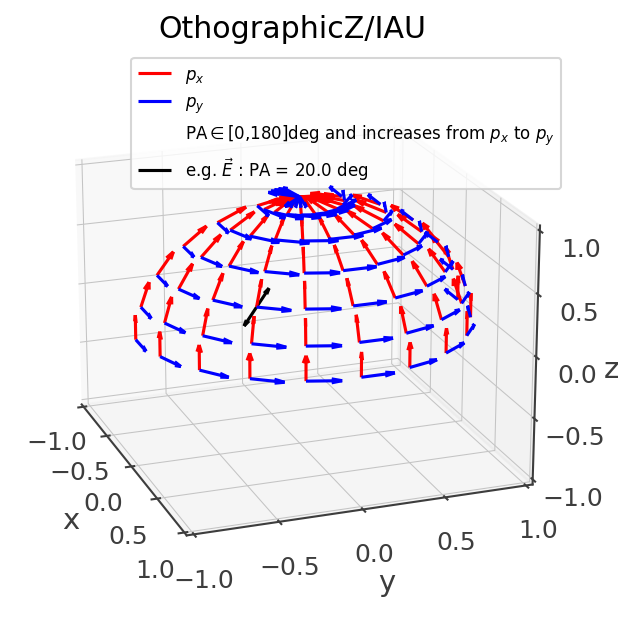
This matches the IAU convention and can be also called by name:
PolarizationConvention.get_convention("IAU")
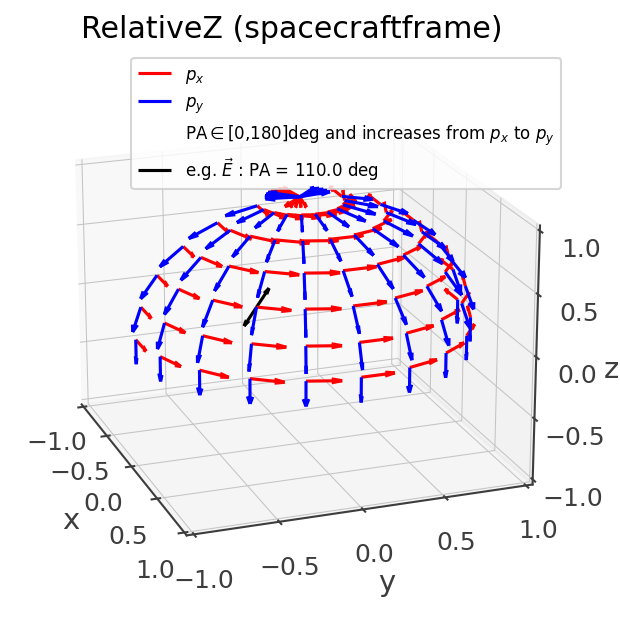
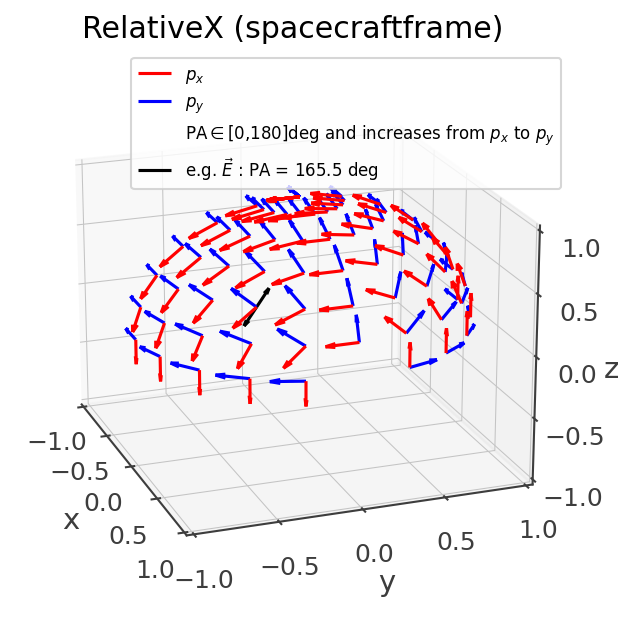
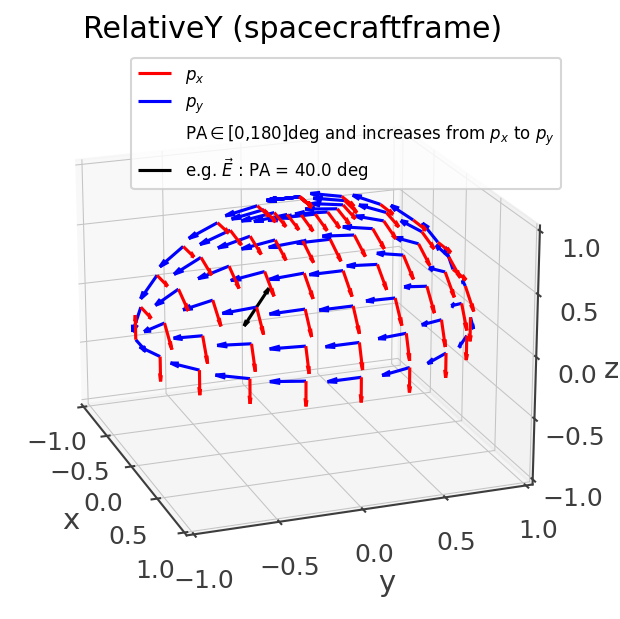
Other special conventions of the orthographic family that can also be called by name are MEGAlibs RelativeX/Y/Z, where the -py vector points towards the reference vector (as opposed to px):
Stereographic
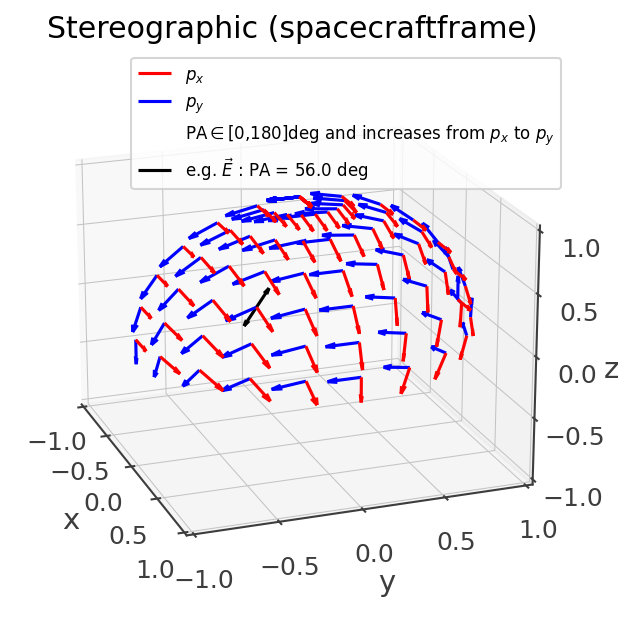
An issue of the orthographic projection is that it is not well-defined at the location of the reference vector and its antipodal direction. This can cause issues due to numerical errors when construction a detector response near those locations. The stereographic convention is meant to solve this issue by describing the polarization angle in spacecraft coordinates with only a single undefined location at -z, where the effective area is almost null. Due to the hairy ball theorem it is impossible to obtain a convention where the polarization basis vector have a smooth transition and with undefined locations.
Near the z-axis, it is very similar to using an orthographic convention with +x as the reference vector, and it deviates near and below the equator:
Converting from one convention and/or frame to another
Use the transform_to function:
pa_inertial =  PolarizationAngle(20*u.deg, source_direction, convention = 'IAU')

pa2_sc = pa.transform_to('RelativeX', attitude = Attitude.from_rotvec([0,10,0]*u.deg))

print(pa2_sc.angle.degree)
Results in 161.95. Note that in addition to accounting for the difference polarization reference vector, it also transforms from one reference frame to another on the fly.
Classes
- class cosipy.polarization.PolarizationConvention[source]
-
- get_convention_registered_name(convention_class)[source]
Opposite of get_convention. Returns None if not found.
- property frame
Astropy coordinate frame
- get_basis_local(source_vector: numpy.ndarray)[source]
Get the px,py unit vectors that define the polarization plane on this convention, and in the convention’s frame.
Polarization angle increments from px to py.
- Parameters:
source_vector (np.ndarray) – Unit cartesian vector. Shape (3,N)
- Returns:
px,py – Polarization angle increases from px to py. pz is always the opposite of the source direction –i.e. in the direction of the particle.
- Return type:
np.ndarray
- get_basis(source_direction: astropy.coordinates.SkyCoord, *args, **kwargs)[source]
Get the px,py unit vectors that define the polarization plane on this convention. Polarization angle increments from px to py.
- Parameters:
source_direction (SkyCoord) – The direction of the source
- Returns:
px,py – Polarization angle increases from px to py. pz is always the opposite of the source direction –i.e. in the direction of the particle.
- Return type:
SkyCoord
- class cosipy.polarization.OrthographicConvention(ref_vector: ~typing.Optional[~typing.Union[astropy.coordinates.SkyCoord, numpy.ndarray.<class 'float'>]] = None, frame: ~typing.Optional[astropy.coordinates.BaseCoordinateFrame] = None, clockwise: bool = False)[source]
- property ref_vector
- property is_clockwise
When looking at the source
- property frame
Astropy coordinate frame
- get_basis_local(source_vector: numpy.ndarray)[source]
Get the px,py unit vectors that define the polarization plane on this convention, and in the convention’s frame.
Polarization angle increments from px to py.
- Parameters:
source_vector (np.ndarray) – Unit cartesian vector. Shape (3,N)
- Returns:
px,py – Polarization angle increases from px to py. pz is always the opposite of the source direction –i.e. in the direction of the particle.
- Return type:
np.ndarray
- class cosipy.polarization.StereographicConvention(clockwise: bool = False, attitude: scoords.Attitude = None)[source]
- property frame
Astropy coordinate frame
- class cosipy.polarization.PolarizationAngle(angle, source: astropy.coordinates.SkyCoord = None, convention='iau', *args, **kwargs)[source]
- property angle
- property convention
- property source
- property vector
Direction of the electric field vector
- classmethod from_scattering_direction(psichi, source_coord, convention)[source]
Calculate the azimuthal scattering angle of a scattered photon.
- Parameters:
psichi (astropy.coordinates.SkyCoord) – Scattered photon direction
source_coord (astropy.coordinates.SkyCoord) – Source direction
convention – cosipy.polarization.PolarizationConvention
- Returns:
azimuthal_scattering_angle – Azimuthal scattering angle
- Return type:
- class cosipy.polarization.PolarizationAxis(*args: Any, **kwargs: Any)[source]
Defines a polarization axis compatible with PolarizationAngle.
Parameters: edges (array-like):
Bin edges. Can be a Quantity array or PolarizationAngle
- conventionPolarizationConvention
Convention defining the polarization basis in the polarization plane (for which the source direction is normal). Overrides the convention of “edges”, if a PolarizationAngle object was provided
- label (str): Label for axis. If edges is an Axis object, this will
override its label
unit (unit-like): Unit for axis (will override unit of edges) copy (bool): True if edge array should be distinct from passed-in
edges; if False, will use same edge array if possible
- property convention
- property lower_bounds
- property upper_bounds
- property bounds
- property lo_lim
- property hi_lim
- property edges
- property centers